Xinouhua Power
Choosing the right LED Driver can determine whether a lighting project performs reliably or disappoints after installation. The choice affects brightness, efficiency, heat, flicker, dimming, and service life. A small retail display, warehouse high-bay, and outdoor sign need different electrical solutions.
Michael Poplawski, a lighting technology development manager at the U.S. Department of Energy, has stated, “LEDs are not light bulbs.” This simple observation matters. An LED requires controlled current, not merely a compatible voltage source. The driver must match the LED module’s forward-voltage range and operating current. Check both values carefully.
Begin with the fixture’s real conditions. Measure available input voltage. Identify whether the system needs constant current or constant voltage. Then examine dimming requirements, ambient temperature, enclosure space, and expected operating hours. A driver rated for 700 mA may damage a module designed for 350 mA. Heat can create trouble quietly.
Look for efficiency, power factor, low standby consumption, and suitable protection features. Over-temperature and short-circuit protection can reduce risk during unexpected faults. Certification marks and documented testing also support a more trustworthy specification. Still, paperwork is not proof of perfect field performance.
Test the selected driver with the actual LED module. Not a similar one. The wiring length, connectors, and enclosure can change results. Watch for visible flicker, buzzing, excessive heat, or unstable dimming. I have learned that a technically correct datasheet can still hide an inconvenient installation detail. Choosing well requires calculation, inspection, and a willingness to question the first assumption.
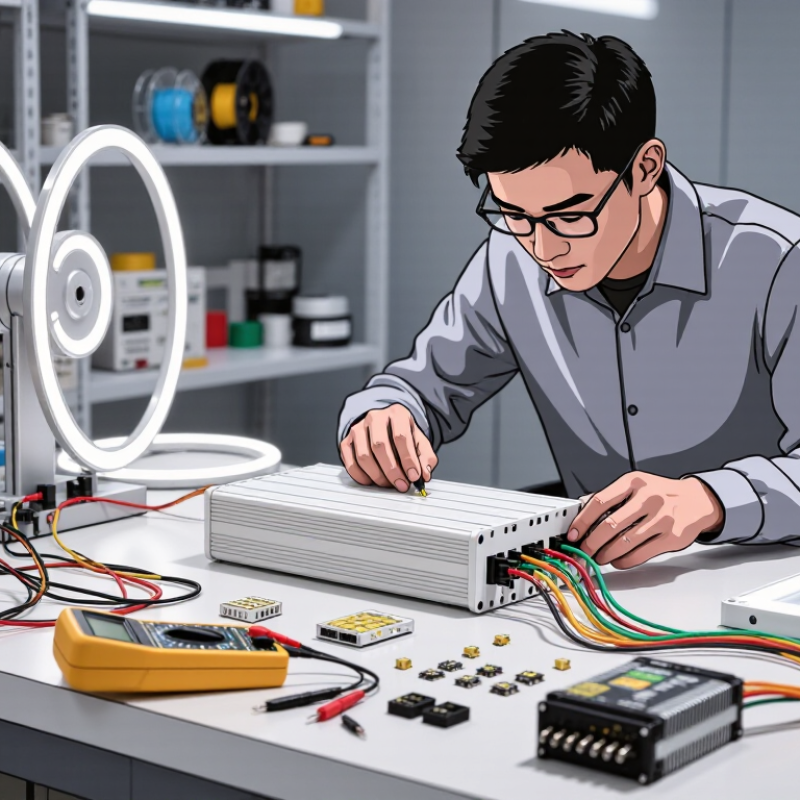
An LED driver is the control point between the power source and the LED module. It converts voltage, regulates current, and protects the light engine from surges, heat, and unstable supply. That role becomes more important as LED adoption expands. The International Energy Agency’s Energy Efficiency 2023 report noted that LEDs represented more than half of global lighting sales in 2022. More installations also mean more mismatched drivers in real projects. Small errors become visible.
Constant-current drivers suit LEDs specified by a forward-current range. They are common in downlights and high-power modules. Constant-voltage drivers deliver 12 or 24 volts for strips and modules with onboard resistors. AC/DC drivers connect directly to mains, while DC/DC versions regulate an existing low-voltage supply. For dimming, confirm the control method: PWM, 0–10 V, resistance, or digital signaling. Compatibility is not automatic.
Start with the LED’s rated current and forward-voltage window, not only its wattage. Then check efficiency, power factor, harmonic distortion, ripple, standby power, and thermal limits. The U.S. Department of Energy’s 2023 Solid-State Lighting R&D Opportunities report cites laboratory LED efficacy above 200 lumens per watt, but installed systems usually perform lower. Leave practical headroom, without oversizing unnecessarily. A 60-watt load does not automatically need a 100-watt driver. That shortcut looks sensible. On a humid exterior wall, enclosure rating, surge protection, and cable glands may matter more than laboratory efficiency. Datasheets can be easy to overtrust; installation temperature and wiring length can change the result.
How to Choose the Right LED Driver for Your Project
Selecting an LED driver starts with the LED’s electrical requirements, not the fixture’s appearance. Check the datasheet for forward voltage, operating current, and total power. A constant-current driver suits LEDs specified by milliamps. A constant-voltage driver suits modules designed for a fixed voltage, such as 12V or 24V. Mixing these categories can cause flicker, overheating, or early LED failure. I have seen a visually perfect installation fail because its driver type was wrong.
Match the driver’s output voltage to the LED load. For constant-current systems, confirm that the LED voltage range falls inside the driver’s stated output range. Then match current closely. Excess current may produce brighter light briefly, but it can damage the LED junction. Lower current is usually safer, though it may reduce brightness. Check the figures twice. Small errors matter.
Calculate power with this formula: voltage multiplied by current. Choose a driver with suitable capacity, but avoid excessive oversizing. A modest reserve, often around 10% to 20%, can support stability without wasting energy. Also inspect efficiency, dimming compatibility, protection features, and operating temperature. Keep the driver ventilated, especially inside a sealed enclosure. Field conditions are rarely ideal. Ambient heat, cable losses, and installation mistakes can change the result. Rechecking the design after a temperature test is worthwhile.
Choosing the right LED driver starts with understanding the load. Constant-current drivers regulate the current flowing through the LED. They suit high-power LEDs and fixtures with a specified operating current. The output voltage changes within a rated range. This helps maintain consistent brightness and reduces stress caused by current fluctuations.
Constant-voltage drivers provide a fixed voltage, such as 12V or 24V. They are commonly used with LED strips and modules that include built-in current-limiting components. Every connected load must match the driver’s voltage exactly.
A frequent mistake is connecting bare LEDs directly to a constant-voltage source. They may become dangerously bright, overheat, and fail quickly. I have seen small wiring assumptions create large thermal problems.
Tips: Read the LED datasheet before selecting the driver. Match voltage, current, wattage, and dimming requirements. Leave practical headroom instead of running the driver at its maximum rating. For example, a 60W load may benefit from a driver rated above 60W. Check the enclosure, cable length, ventilation, and ambient temperature too. Long cables can cause voltage drop, while poor airflow can shorten LED life. Testing at full brightness for several hours is useful, although it does not replace proper electrical verification. When uncertain, measure the actual operating current and review the installation against applicable safety requirements.
Choosing the right LED driver begins with the lighting load, not the driver’s advertised power rating. Confirm the LED voltage, current, total wattage, and expected operating temperature. A driver rated slightly above the load may provide useful headroom, but excessive capacity can reduce control quality at low output.
Dimming performance deserves careful testing. Check whether the driver supports PWM, analog dimming, or digital commands required by your controller. Some systems dim smoothly at 100 percent but flicker below 10 percent. Test the actual LED module, wiring length, and minimum brightness in a dark room. Flicker can be difficult to notice during normal use, yet it may appear in phone videos or affect sensitive users. I once approved a dimming setup too quickly. It worked on the bench, but produced visible steps after installation.
Efficiency affects heat, operating cost, and service life. Review efficiency across the expected load range, not only at full power. Protection features should include overcurrent, short-circuit, overvoltage, and thermal protection. These functions reduce risk, but they do not replace correct installation or ventilation. Mount the driver away from trapped heat, and allow space around its case. A cooler driver is usually a more dependable driver.
Control features also need practical attention. Check startup behavior, fault reporting, address settings, and compatibility with sensors or building controls. Keep control cables separated from noisy power wiring when possible. During commissioning, record voltage, current, temperature, and dimming response. My measurements are not always as complete as they should be, so I now photograph the test readings before closing the enclosure.
A practical comparison of LED driver types based on dimming, efficiency, protection, control, and installation requirements.
| Driver Category | Typical Output Configuration | Common Dimming Methods | Typical Efficiency Range | Protection Features to Verify | Control and Integration Options | Best-Fit Applications | Key Selection Consideration |
|---|---|---|---|---|---|---|---|
| Constant-Current LED Driver | Fixed output current, commonly 250–1,400 mA; output voltage varies with the LED load. | Analog current reduction, PWM, 0–10 V, or digital control, depending on the model. | 85%–95% | Short-circuit, open-load, over-temperature, over-voltage, and input surge protection should be confirmed. | May support 0–10 V, DALI, DMX, wireless controls, or a simple enable/PWM input. | Commercial luminaires, outdoor fixtures, downlights, linear lighting, and high-power LED modules. | Match the rated current to the LED array and ensure the required voltage range covers the complete load. |
| Constant-Voltage LED Driver | Regulated output such as 12 VDC or 24 VDC for LED strips, modules, and other loads with internal current regulation. | PWM on the supply output, remote PWM input, or compatible dimming controller. | 85%–94% | Short-circuit, overload, over-temperature, input surge, and output over-voltage protection are commonly evaluated. | PWM controllers, wall dimmers, building-control interfaces, and standalone remote controls. | LED tape, signage, display lighting, cabinet lighting, and decorative installations. | Confirm the output voltage, total load wattage, wiring voltage drop, and at least 10%–20% usable power margin. |
| Non-Dimmable AC/DC Driver | Fixed constant-current or constant-voltage output with no dedicated dimming interface. | Usually no dimming; some units may support mains switching only. | 80%–92% | Input over-voltage, short-circuit, overload, thermal shutdown, and surge protection should be checked. | Basic on/off switching, relay control, or occupancy-sensor switching. | Utility lighting, service areas, low-cost fixtures, and applications requiring full output. | Use only when a fixed light level is acceptable and future dimming is not required. |
| Phase-Cut Dimmable Driver | AC mains input with regulated LED output; designed for forward-phase or reverse-phase dimmers. | Triac, leading-edge, trailing-edge, or universal phase-cut dimming, subject to compatibility. | 80%–92% | Over-temperature, short-circuit, input surge, overload, and abnormal mains protection are important. | Residential wall dimmers, retrofit controls, and simple architectural lighting systems. | Residential downlights, lamps, hospitality areas, and retrofit projects. | Check minimum load, dimmer compatibility, flicker performance, audible noise, and low-level dimming behavior. |
| 0–10 V Dimmable Driver | Constant-current or constant-voltage output with a separate low-voltage analog dimming input. | 0–10 V or 1–10 V analog control; some designs provide dim-to-off or require a separate relay. | 85%–94% | Output short-circuit, thermal, over-voltage, input surge, and control-input fault protection should be reviewed. | Building automation systems, wall stations, occupancy sensors, daylight sensors, and relays. | Offices, classrooms, retail spaces, warehouses, and commercial lighting zones. | Verify the control polarity, sink/source compatibility, minimum dimming level, and standby power behavior. |
| DALI-Compatible Driver | Regulated LED output with a two-wire digital lighting-control interface. | Digital level setting, grouping, scenes, fade times, and scheduled control through the DALI system. | 85%–94% | Thermal, overload, short-circuit, output over-voltage, input surge, and communication fault behavior should be verified. | Digital addressing, group control, scene setting, status feedback, and building-management integration. | Large commercial buildings, hotels, healthcare facilities, museums, and projects needing detailed zoning. | Confirm the installed control system, bus-power requirements, addressing capacity, and emergency-lighting compatibility. |
| PWM-Controlled Driver | Constant-current or constant-voltage output controlled by a pulse-width-modulated signal. | PWM duty-cycle control, typically using a low-voltage control signal or external dimmer. | 85%–95% | Short-circuit, over-current, thermal shutdown, input surge, and protection against incorrect control wiring. | Microcontrollers, lighting controllers, DMX decoders, automation panels, and custom electronics. | Color-changing systems, entertainment lighting, architectural accents, and embedded products. | Check PWM frequency, control voltage, signal amplitude, minimum duty cycle, and visible-flicker requirements. |
| Outdoor or Enclosed Driver | Constant-current or constant-voltage output in a sealed or weather-resistant enclosure. | 0–10 V, PWM, phase-cut, DALI, or on/off control depending on the design. | 82%–92% | Look for an appropriate IP rating, surge protection, lightning-transient protection, thermal management, and moisture resistance. | Photocells, timers, wireless controls, 0–10 V, DALI, or centralized outdoor-control systems. | Street lighting, facade lighting, landscape lighting, parking areas, signs, and exterior architectural projects. | Evaluate ambient temperature, enclosure ventilation, cable glands, surge level, mounting orientation, and condensation risk. |
Choosing an LED driver starts with the installation environment, not wattage alone. Measure the supply voltage, available space, ambient temperature, and expected load range. A driver rated for indoor use may fail inside a hot, sealed enclosure. Check airflow, moisture, dust, and cable length before installation. I have learned this the hard way. A cool workshop can hide a dangerously hot ceiling void.
Compatibility requires more than matching voltage. Confirm constant-current or constant-voltage operation, output current, dimming protocol, minimum load, and inrush behavior. The U.S. Department of Energy’s 2019 Solid-State Lighting forecast projected that LED adoption could save about 1,595 terawatt-hours annually by 2035. Those savings depend on correctly matched components, not LED efficiency alone. A poor match can create flicker, noise, or shortened service life. That assumption can fail.
Review compliance evidence before purchasing. IEC 61347-1 and IEC 61347-2-13 address general and LED-module controlgear safety. IEC 60598-1 covers luminaire safety, while IEC 60529 defines enclosure protection ratings. For electromagnetic performance, review applicable limits under IEC 61547 and IEC 61000-3-2. Ask for test reports, temperature ratings, insulation details, and protection against short circuit and overload. Certificates deserve verification. Paperwork can be incomplete. Have a qualified installer inspect grounding, polarity, clearances, and strain relief before energizing the circuit.
Verifying installation conditions, compatibility, and safety standards
The chart compares the two digits in selected IP codes defined by IEC 60529. The first digit indicates protection against solid objects and dust, while the second digit indicates protection against water. Select a driver whose enclosure rating matches the installation environment; the required rating should be confirmed from the complete project specification.
It connects the power source to the LED module. It converts voltage and regulates current. It also limits surges, heat, and unstable supply. Small errors matter.
Constant-current drivers suit LEDs specified by milliamps. Constant-voltage drivers suit modules designed for 12V or 24V. Mixing them can cause flicker, overheating, or early failure. Check the datasheet carefully.
Check forward voltage, operating current, and total power. Do not select a driver by wattage alone. For constant-current systems, keep the LED voltage within the driver’s output range. Test it twice.
A reserve of about 10% to 20% often supports stable operation. Excessive oversizing may reduce low-level dimming quality. A 60-watt load does not automatically need a 100-watt driver. More capacity is not always better.
Confirm support for PWM, analog, resistance, or digital control. Test the actual LED, controller, and wiring together. Some systems dim smoothly at full output but flicker below 10%. A dark-room test can reveal visible stepping.
Look for overcurrent, short-circuit, overvoltage, and thermal protection. These features reduce risk during faults. They cannot replace correct wiring or ventilation. Protection is helpful, not magical.
Keep it away from trapped heat. Allow space around the case for airflow. Outdoor installations may require suitable enclosure protection and cable glands. Humidity changes the calculation.
Record voltage, current, temperature, and dimming response. Check performance across the expected load range. Cable length and ambient heat can change the result. I once trusted bench testing too much.
Choosing the right LED Driver is essential for achieving reliable performance, consistent brightness, and long service life in an LED lighting project. Start by understanding the driver’s role: it regulates electrical power and protects LEDs from unstable input conditions. Select a constant-current driver for LEDs that require a precise current level, or a constant-voltage driver for systems designed to operate at a fixed voltage. Carefully match the driver’s output voltage, current, and total power capacity with the LED specifications, while allowing suitable operating headroom.
Beyond basic electrical ratings, evaluate features that support the project’s practical needs. Consider dimming methods, energy efficiency, thermal management, overload and short-circuit protection, and available control interfaces. Installation conditions also matter, including ambient temperature, moisture exposure, ventilation, enclosure space, and wiring requirements. Before installation, confirm compatibility among the driver, LEDs, controls, and power supply, and verify that the equipment meets applicable safety and electrical standards. A complete evaluation helps ensure dependable operation and safer, more efficient lighting.